English language education in Vietnam has long followed an EFL model, positioned primarily as a classroom subject rather than a language embedded in social life. As Vietnam accelerates its integration into the global economy, this model is increasingly misaligned with the linguistic demands of international trade, higher education, digital innovation, and knowledge production. In response, the Vietnamese government has launched an ambitious national plan (2025–2035) to reposition English as a second language in schools, signaling an intention to harness linguistic capacity as a driver of economic growth and global competitiveness. While similar policy trajectories can be observed in countries such as Singapore, Malaysia, India, Rwanda, and the Philippines, where English has been strategically enhanced to support global market participation and knowledge access, Vietnam’s pathway is shaped by distinct historical, sociolinguistic, and developmental conditions. Unlike contexts where English has long functioned as a postcolonial, administrative, or societal language, Vietnam’s transition occurs later, within a multilingual but largely Vietnamese-dominant environment, and under different institutional, demographic, and ideological constraints. Consequently, the temporal pace, implementation logic, and societal implications of repositioning English in Vietnam are unlikely to mirror those of earlier adopters.
When English is repositioned as a second language, it raises a practical question about which model of English will guide policy, curriculum, assessment, and teacher education. This means the country needs to decide explicitly or implicitly whether the shift aligns most closely with a World Englishes orientation, an English as a Lingua Franca perspective, or a Global Englishes framing. World Englishes has been especially influential in legitimizing locally developed, socially embedded varieties of English, with analytic attention to ownership, identity, local norm development, and sociopolitical status, often discussed through the lens of concentric circles. At the same time, scholarship has noted that World Englishes research has tended to focus more heavily on Inner/Outer Circle settings and, comparatively, has paid less sustained attention to everyday interaction among multilingual speakers in Expanding Circle contexts, where English is used primarily for cross-border and cross-community communication. This is one reason English as a Lingua Franca has grown as a complementary lens. English as a Lingua Franca centers on English as situated multilingual practice, where norms are negotiated locally and communicative success depends on accommodation, pragmatic strategies, and shared meaning-making rather than alignment to a single external standard. Building from these developments, some scholars use Global Englishes as an umbrella intended to integrate World Englishes, English as an International Language, and English as a Lingua Franca orientations while engaging more directly with pedagogical uptake and teacher education. Of course, there remains ongoing debate about how best to preserve the distinctive insights of each framework.
Positioning the ESL trajectory of Vietnam within these paradigms helps clarify why moving from EFL to ESL is not a uniform or linear pathway that can be replicated from other national cases. A World Englishes lens highlights whether, over time, English in Vietnam becomes more institutionally stabilized through sustained domains of use, localized norms, and identity-linked functions. An English as a Lingua Franca lens points in a different direction. It suggests that much of Vietnam’s near-term expansion may take the form of domain-specific lingua franca use, with English functioning as a flexible communicative resource across universities, workplaces, digital platforms, and transnational networks, often without converging on a single national variety. English as a Lingua Franca research also shows that lingua franca communities can be short-lived or relatively stable. Even durable groups can develop shared conventions through mutual accommodation. However, the broader ecology remains shaped by mobility and multilingual mixing rather than classic speech-community consolidation.
This matters for Vietnam because the early-stage strategy of the government expands English beyond a discrete subject. It introduces English as a language for instruction in selected subjects and settings and frames it as a functional second language within educational institutions. In the short term, this may intensify contact-driven variation rather than produce immediate standardization. From an English as a Lingua Franca perspective, learners and teachers may follow overlapping similect trajectories shaped by first-language influence and multilingual repertoires. They may also engage in multilingual language-crossing practices that are typical of lingua franca communication. For curriculum and assessment, this points to the need to distinguish between two types of targets. The first type involves outcomes aimed at local institutional bilingualism, including school-based ESL and EMI functions. The second type involves competencies aimed at international intelligibility and interactional effectiveness in diverse English as a Lingua Franca environments. This distinction matters because measures narrowly benchmarked to Inner Circle standardization may not align with the realities of second-language use.
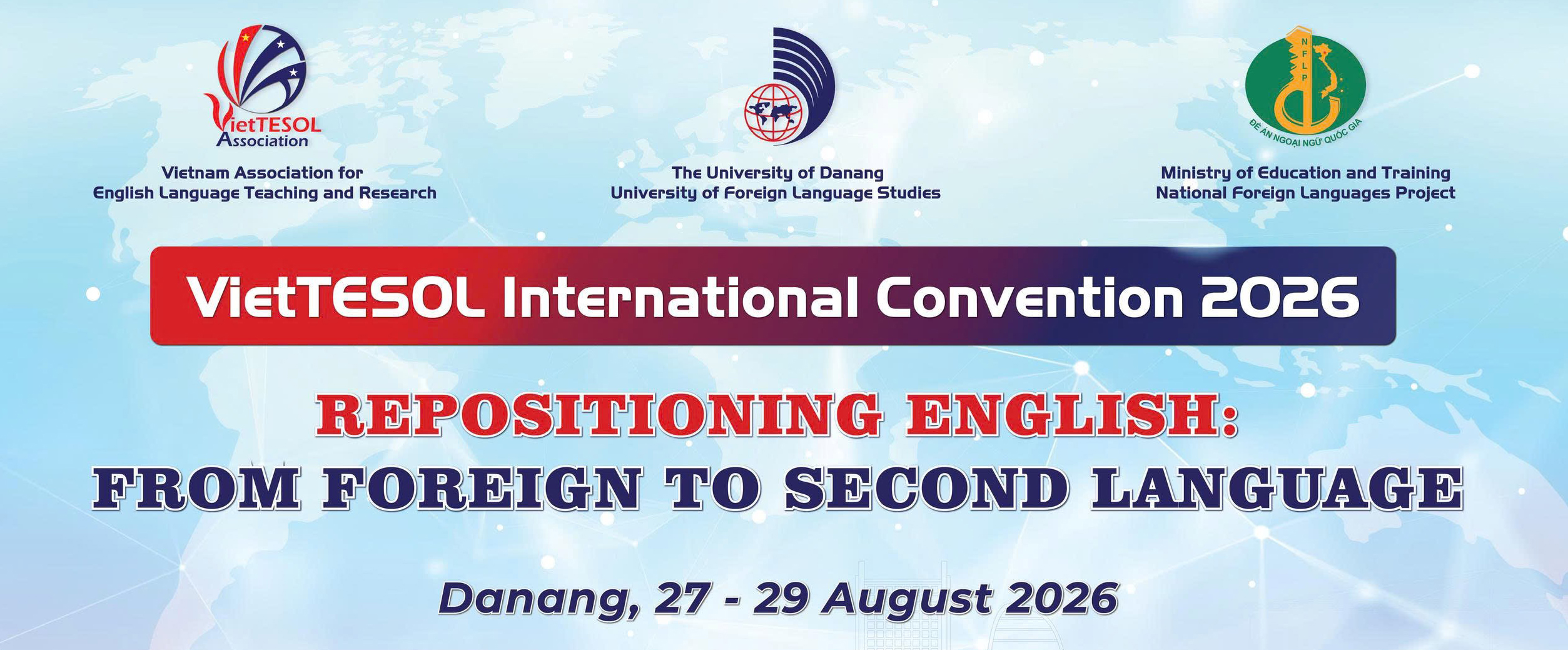
The Vietnam Association of English Language Teaching and Research (VietTESOL), in collaboration with the National Foreign Languages Project (NFLP) and University of Foreign Language Studies - The University of Danang, holds the annual VietTESOL International Convention in Danang City from August 27 to 29, 2026. In conversation with regional experiences across Asia and wider global debates, the convention invites participants to examine how countries like Vietnam can design policy and pedagogy for an ESL trajectory. It foregrounds key conceptual and practical tensions, including how to balance World Englishes concerns with English as a Lingua Franca priorities in increasingly transnational communicative environments. The convention welcomes new and contemporary research and practice that explores the multifaceted work of repositioning English from a foreign language to a second language in Vietnam and comparable contexts. Participants will engage in discussions on curriculum redesign, language-of-instruction models, learner support and inclusion, teaching methodology, assessment and accountability, teacher professional development, and technology integration, including the opportunities and risks associated with digital and AI-driven tools. The convention aims to shape the future of English language education in ways that are pedagogically sound, socially sustainable, and regionally and globally connected, while supporting the developing roadmap of Vietnam toward an ESL future. Abstract submissions are categorized into five strands.
Strand 1: EFL to ESL Transition and Language Policy
Strand 2: Technology and Second Language Learning
Strand 3: Language Pedagogy and Curriculum
Strand 4: Language and Linguistics
Strand 5: Teacher Professional Development and Professional Learning
More details is available at Call for Abstracts, and submissions are welcomed at Submission menu.
Contact
Email: convention@viettesol.org.vn
Support: Convention Team
Website: https://convention.viettesol.org.vn | https://viettesol.org.vn
Fb Fanpage: https://www.facebook.com/VietTESOL.org.vn